Wednesday, 19 November 2014

BOKO HARAM/CHIBOK/CEASE FIRE ARE ALL POLITICAL GAME

Editor's note: Tolu Ogunlesi is a Nigerian journalist who was awarded the Arts and Culture prize in the 2009 CNN MultiChoice African Journalist Awards.
(CNN) -- On Friday, October 17, Alex Badeh, Nigeria's most senior military official, announced in the Nigerian capital Abuja that "a ceasefire agreement has been concluded" with the terrorist group Boko Haram.
"I have accordingly directed the [military] chiefs to ensure immediate compliance with this development in the field," he said.

More than one government official followed up with claims that the release of the more than 200 schoolgirls abducted in April was one of the concessions extracted from the terrorist group as part of the truce.
Now, more than three weeks later, there's nothing to suggest that Boko Haram is keen on peace. A video released on November 1 shows a man believed to be sect leader Abubakar Shekau denouncing the so-called deal and vowing to continue the campaign of terror. The abducted girls, Shekau taunts, "are in their marital homes." The sect has also continued to attack and capture towns and villages in the north east -- including, a week ago, Air Marshal Badeh's home town.
Recent history -- a long line of failed attempts to negotiate with, or pacify, Boko Haram -- should have inspired some wariness on the part of the government.
In 2011, Kashim Shettima, then Governor-Elect of Borno, the state worst-hit by the violence, said his government would "offer them amnesty as long as they lay down their arms and embrace peace."
The offer was rejected by someone who claimed to be a spokesperson for the sect, for two reasons; "first we do not believe in the Nigerian constitution and secondly we do not believe in democracy but only in the laws of Allah."
At every turn the Nigerian government -- everything from the president's office, to the military, and intelligence services -- has demonstrated that it is as confused as the rest of us.

A few months later, former Nigerian President Olusegun Obasanjo travelled to Maiduguri, where the group started out from more than a decade ago, to discuss with the family of Mohammed Yusuf, the sect's founder (whose controversial death in police custody in 2009 triggered the sect's bloody uprising). Barely 48 hours after the meeting, the man who hosted Obasanjo on behalf of the family was shot dead by unknown gunmen.
In April 2013 the Federal Government set up a "Presidential Committee on the Dialogue and Peaceful Resolution of Conflicts in Northern Nigeria." Days later a man claiming to be a Boko Haram spokesperson rejected the amnesty. This was followed by a Hausa language audio recording released to journalists in which a man purporting to be sect leader Abu Shekau, said: "We are the ones to grant them pardon. Have you forgotten their atrocities against us?"

Nonetheless, the government pushed ahead with the plan; the head of the committee announced a ceasefire in July. As 2013 came to an end, Boko Haram intensified its activities, culminating in the abduction of the schoolgirls this April.

Around July this year, presumably inspired by ISIS, it started to seize -- and hold -- territory.
It was against this alarming backdrop that the news of the latest ceasefire emerged, to much relief from around the world.
Now that the ceasefire deal has proven to be a sham, several questions linger: What did the government do to verify the legitimacy of the Boko Haram negotiator? What was the plan regarding the swathes of Nigerian territory seized and held by Boko Haram, pre-ceasefire?
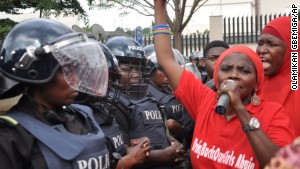
And, most importantly, why did the federal government, aware of how every previous talk of a ceasefire has turned out, fail to exercise greater caution with this latest one, even in the face of valid concerns by those who should know.

The answer to the last question may be found in the fact of Nigeria's brutal, winner-takes-all politics. In the general elections forthcoming early next year, President Jonathan will be seeking a second and final term. It should have been a walkover for the incumbent, as presidential elections traditionally are in these parts. But a potential game-changer emerged last year: a merger of Nigeria's leading opposition parties -- producing arguably the strongest and most determined opposition alliance a Nigerian ruling party has ever faced.

Both parties have stridently sought to capitalize on the Nigeria's dire security situation in northeastern Nigeria; the ruling Peoples Democratic Party (PDP) by alleging that the opposition All Progressives Congress (APC) is sympathetic to Boko Haram and is sponsoring the insurgency to undermine Mr. Jonathan's government, and the APC by highlighting the success of Boko Haram as evidence of the incompetence of President Goodluck Jonathan and his government.

When the news broke -- at a time when opposition presidential candidates were launching their campaigns, and when speculation was rife that the President was due to declare his own bid soon -- more than a few people saw it as a move by a beleaguered government to counter allegations of incompetence, and shore up its image. The release of the abducted girls would no doubt have boosted Mr. Jonathan's re-election chances.

It seems likely that it is this obsession with the approaching elections that fueled the government's shocking gullibility in this matter; allowing it to be hoodwinked into going to town with news of a deal swathed in red flags.

The fact that no room was left for doubt or caution is shocking, considering that it is open knowledge that Boko Haram, far from possessing a unified command, is actually a chain of factions varying widely in motivation and method, presumably "too fragmented to present a common front for dialogue."
The government's blindness -- willful or otherwise -- to that fact should alarm us all. But it's not very surprising.

At every turn the Nigerian government -- everything from the president's office, to the military, and intelligence services -- has demonstrated that it is as confused as the rest of us.
We see this not just in the desperation, at the highest levels, to believe anything regardless of how implausible it sounds, but also in the supremely careless manner in which information regarding the crisis continues to be managed.
If the past is anything to go by, I'm certain we haven't seen the last of the "ceasefire" announcements.

MUST WIN GAME FOR NIGERIA

Reigning champions Nigeria will be desperate to emerge from the final round of 2015 Africa Cup of Nations qualifying on Wednesday with one of the six remaining spots for the tournament.
With 10 countries already qualified for the 17 January to 8 February showpiece in Equatorial Guinea , five more will join them as one of the top two teams in the groups, while one more will go through as the best third-placed side.
Nigeria's campaign has besieged by problems both on and off the field, which has put them in serious danger of failing to earn the right to defend their title.
But they go into their final match against already-qualified South Africa with their fate in their own hands after they beat Congo 2-0 on Saturday.
"It was not an easy game against a very determined Congo side, but luck was on our side. We took a big step forward (by this win)," said coach Stephen Keshi, who will be without Reading midfielder Hope Akpan, who dislocated his shoulder in Congo, and the suspended Godfrey Oboabona.

Burkina Faso's Lt Col Isaac Zida named prime minister

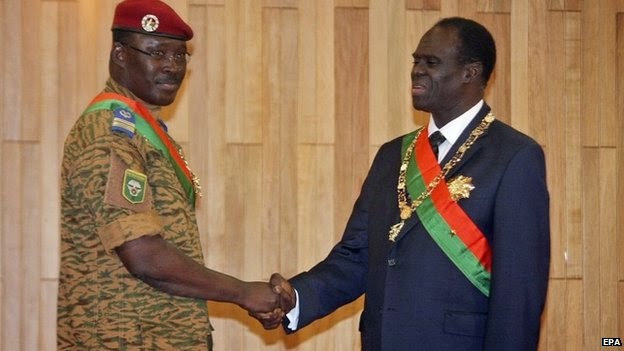
The authorities in Burkina Faso have appointed an army officer, Lt Col Isaac Zida, as transitional prime minister.
Col Zida had been among officers who took power when then President Blaise Compaore was forced to resign on 31 October during mass protests.

Lt Col Zida handed over as head of state to Michel Kafando on Monday
He declared himself head of state but on Tuesday oversaw the swearing-in of former Foreign Minister Michel Kafando as interim president.
The moves followed agreement on a year-long transition to elections.

The transitional charter will see an interim legislative chamber installed until elections are organised next year.
Mr Compaore first seized power in a coup in 1987 and went on to win four disputed elections.
Tens of thousands of people protested in Ouagadougou in October against moves to allow him to extend his rule.


Source:BBC

Tuesday, 18 November 2014

CAMEROOM TROOPS BETTER THAN THE NIGERIA SOLDIERS

Cameroon's military are battling cross-border raids by Nigeria's militant Islamist group Boko Haram, as the BBC's Thomas Fessy found out when he joined soldiers on a patrol.
A soldier is standing on the back of a flatbed pick-up truck leading the convoy.
B/Haram attacked  military post in the border village of Amchide

His high-powered twin-barrelled gun is turned towards Nigeria. In reality, though, the weapon is aimed at what Boko Haram call their "caliphate", or Islamic state.
The border village of Amchide is mostly deserted. Only a handful of people can be seen as we drive through.
They are hastily throwing a few belongings on a cart as they prepare to leave. They probably did not have time to take anything when they fled during an attack, and came back to recover their possessions.
The dusty road is the line that the militants keep crossing on almost a daily basis now, attacking the villages and Cameroonian army positions. 

Many of them walked long distances to escape Boko Haram
"Every day, there are gunshots," a Cameroonian commander says.
He explains that the situation is so tense that he would rather stay anonymous.
"They are there; they are turning, watching, trying to know what we are doing and how we can react. It's unpredictable. Boko Haram is like a ghost."

Thousands of Nigerians have fled to Cameroon


The strain is tangible. Cameroon's elite Rapid Intervention Battalion, commonly known by its French acronym BIR, has lost dozens of men since the beginning of the year in the fight against Boko Haram.
About 1,000 men from BIR, trained by US and Israeli forces, have been deployed along a 500-km (300- mile) stretch of porous border with Nigeria.
Boko Haram is advancing and Cameroon's military fight daily battles to keep the boundary with Nigeria - Africa's most populous state - intact.

Cameroon's military recently dispatched another 2,000 soldiers to the border region to reinforce troops.
Last month, Boko Haram attacked the military post at Amchide with a tank.
 
Cameroonian army officer
A car bomb exploded a few metres away minutes before the tank stormed the gate of the Cameroonian base. The tank's charred remains are still to be seen outside the military post.
Cameroonian soldiers complain that they have been left to fight a war which started in another country on their own. 
 

On the other side of the front line, the Nigerian army has fled.
"And the French, where are the French?" an army officer bitterly asks, referring to the French counter-terrorism force commanded from Ndjamena, the capital of Chad, only a few hundred kilometres to the north-east.


Source:BBCAfrica

Palestinians kill Israeli worshippers

Four Israelis have been killed and eight injured as two men armed with a pistol and meat cleavers attacked a West Jerusalem synagogue, police say. The attackers - Palestinians from East Jerusalem - were shot dead.
There have recently been several deadly attacks and clashes in Jerusalem, which has also seen heightened tension over a disputed holy site. 

Israel has vowed to respond "with a heavy hand" to the attack - the deadliest in Jerusalem in six years.
Israeli forces rushed to the scene of the attack,
Prime Minister Benjamin Netanyahu blamed "incitement" by Hamas and Palestinian President Mahmoud Abbas, and said the international community had ignored their actions.
Hamas and Mr Abbas's Fatah party - rival Palestinian factions - agreed to form a unity government earlier this year, a move denounced at the time by Israel. 


Mr Abbas's office issued a statement saying: "The presidency condemns the attack on Jewish worshippers in their place of prayer and condemns the killing of civilians no matter who is doing it."
The Abu Ali Mustafa Brigades, the military wing of the Popular Front for the Liberation of Palestine, says it carried out the synagogue attack.Militants from the far-left-wing Palestinian nationalist group have been behind many previous attacks on Israelis. 

Hamas and another militant group, Islamic Jihad, praised the attack. Israel has designated both groups as terrorist organizations.

SOURCE:BBC

END GAME FOR SUICIDE BOMBER

A suspected male suicide bomber who was allegedly dressed with a bomb hidden under his cloth was apprehended and burnt alive some few minutes after 1pm this afternoon at the Gombe Line Park in Gombe state. Residents of the area said the man was preparing to blow himself up when he was spotted. The mob refused to hand him over to the police and immediately set him on fire.

Monday, 17 November 2014

WICKED BOKO HARAM ATTACKED SCHOOL KIDS

I guess their targets are now schools. A week after a suicide bomber killed about 49 students at Govt Science Secondary school in Yobe state, gunmen attacked Limawa primary and secondary schools, Minna, Niger state this morning at about 10.30am, injuring many students.
According to an eye witness, the attackers shot sporadically in the air before using their machetes to inflict injuries on some students. It is not yet clear if they killed anyone but several students have been rushed to the hospital.

The Niger state Police command spokesperson DSP Ibrahim Gambari, who confirmed the incident, said the police are there now and normalcy has since been returned to the area.